Writing Shopify product descriptions with AI, in bulk
Generating product copy is the easy part. Getting hundreds of listings written, checked, and uploaded without breaking the catalog is the real job.

Bulk AI product descriptions means generating listing copy for a whole catalog from structured product data, then reviewing and uploading it in batches instead of one product at a time. The writing is the easy part. The work sits in the data you feed in, the review step, and getting it into Shopify without breaking anything.
Done well, it is the single biggest time saving in a new store. For one catalog of several hundred products, it took a job that ran around six weeks by hand down to two days.
Why one-at-a-time tools stall on a real catalog
Most AI writing tools for Shopify work inside the product editor: open a product, generate a description, accept it, move on. That is fine for twenty products. For four hundred it is still four hundred rounds of clicking, and the tool often handles only the description, leaving the SEO title, meta description, and image alt text to be written separately or not at all.
Merchants comparing several of these tools on Shopify's community forum have reported the same gaps: middling copy, SEO fields ignored, and some tools unable to run in bulk at all. The problem is not the model. It is that each product is written in isolation, from whatever the tool can see on one page.
Start from structured data, not a blank prompt
A model can only describe what it is told. Give it a product name and it will invent plausible filler. Give it the material, dimensions, finish, use, care instructions, and what makes this item different from the one next to it, and it can write something specific. The real input to a bulk run is a spreadsheet with one row per product and a column for every fact a customer would ask about.
Building that sheet is often the first real work, because the facts are scattered across supplier files, packaging, and someone's memory. It pays twice: the descriptions get better, and you end up with clean product data you can use for filters, feeds, and reporting.
Write every field in one pass
A listing is more than its description. Each product also needs a title that matches how people search, an SEO title and meta description for Google, alt text for its images, and tags that place it in the right collections. Generating them together, from the same data and the same brief, is what keeps a catalog consistent. Writing them in separate passes, or by separate people, is how a store ends up with five different voices.
The brief matters as much as the data. Give the model your brand's tone, a few listings you are proud of, the words you never use, and a length for each field. Those instructions stay fixed for the whole catalog, which is exactly what a person typing listings for six weeks cannot manage.
The review step is not optional
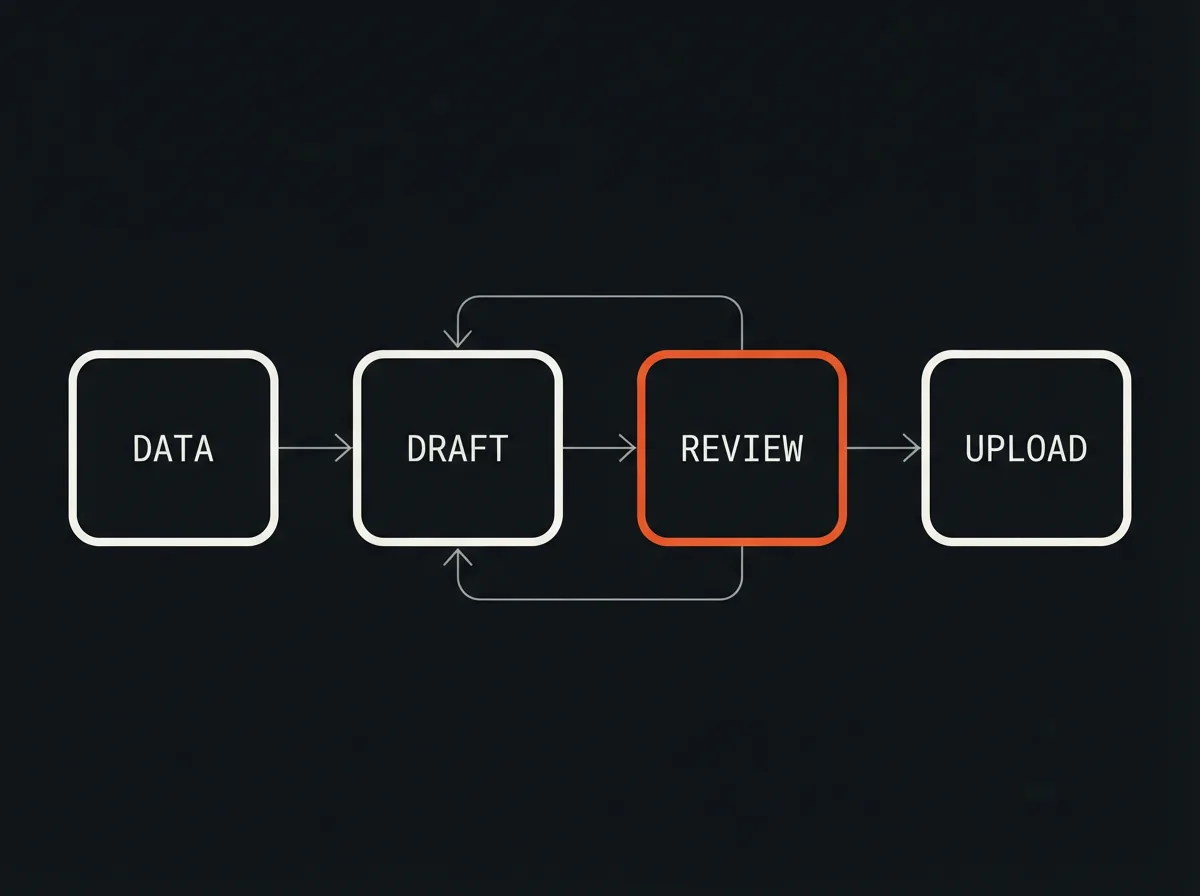
Models state things confidently, including things that are not true. A description that calls a product waterproof when it is water-resistant, or solid wood when it is veneer, turns into returns and complaints. So every bulk run needs a check before anything goes live: compare each generated claim against the source data, flag anything the model added that was not in the sheet, and have a person approve the batch.
The review does not need to read every word of every listing. It needs to catch invented facts, which a script can flag against the source columns, and to spot-check tone on a sample. That keeps a person responsible without putting them back on six weeks of typing.
Getting it into Shopify safely
Shopify accepts bulk product updates through a CSV import in the admin and through its Admin API for larger or repeated runs. Before either, export the current catalog as a backup. Run the first upload on a batch of ten products and check them on the live storefront, including variants and images, before sending the rest. Handles and variant options are where bulk imports most often go wrong, and a small test finds that cheaply.
What it did for one catalog
Wall Nest sells home and wall décor with a catalog in the hundreds of SKUs. Their listings were written by hand, took roughly six weeks for a full refresh, and were inconsistent from product to product. We built an agent that drafts on-brand listings from the product data, formats them, and uploads the products with their images, with review built in. The full catalog now goes live in two days, and the founder's verdict was that the listings read better than the ones they wrote by hand.
That kind of pipeline is what our AI agents and automation work looks like in practice: a repetitive job moved to software, with a person still signing off. For the other store jobs worth automating, see automating an ecommerce store, and for how catalog work shapes a launch date, how long it takes to build a Shopify store.
Questions
What product data does AI need to write good descriptions?
Every fact a customer would ask about: material, dimensions, finish, use, care, variants, and what sets the product apart. Without those, a model fills the gaps with generic or invented copy.
Do AI-written product descriptions hurt SEO?
Not because they are AI-written. Google has said it judges content on its quality rather than how it was produced. Thin, duplicated, or inaccurate descriptions hurt, and specific descriptions built from real product data do not.
How do I bulk upload product descriptions to Shopify?
Use a CSV import from the Products page, or Shopify's Admin API for large or repeated runs. Export the catalog first as a backup, and test on a small batch before uploading the rest.
Who should build your Shopify store depends less on the hourly rate than on who owns and runs it after launch. A plain comparison, written by an agency.
Two stores we built went live in 11 and 12 days, and one catalog took 2. Where the weeks in a Shopify build actually go, and what shortens them.
The right first project is a boring one: a task that repeats every week and eats someone's hours. How to pick it, with two first projects that paid back.